Frank Gehry
A native of Canada, Frank Gehry was born Ephraim Owen Goldberg, but after immigrating to the United States early in life his father changed the family name to “Gehry,” and Frank adopted his current name in his early twenties. Unsure of himself, he began studying architecture at the University of Southern California and fell in love with it, despite his less than prestigious skill at drawing. After graduation he worked as a student for several firms, but was drafted for United States Military for a year. Upon his return, he dedicated himself to receiving a degree from the Harvard Graduate School of Design. However, he was unsuccessful and instead moved with his family to France to work for a French architect.
His return to America in the 1960s and opened his own firm, now known as Gehry Partners, LLP. Gehry began to design buildings with a whole new perspective; houses he would create started to take on distorted shapes and allowed the client to view the structures in the completed projects. Gehry used simple organic materials in his creations, such as plywood, chain linked fences, and metal, which made the buildings and homes all the more interesting and beautiful. He is well known for designing many homes, all uniquely different from those which came before it. His larger scale buildings, as well are famous and have a look of modernism and beauty that is unmatchable.
 |
| Frank Gehry's home |
Among Gehry’s most notable creations can be found his furniture made out of cardboard. This industrial corrugated cardboard was used to create his line called “Experimental Edges,” and became popular. This furniture had rough, shaggy edges and kept up with Gehry’s architectural designs as well. Some sheets of cardboard in this line were intentionally misaligned which created an interesting look that encompassed ripples with the cardboard folds. Along with his cardboard furniture another distinguished creation is his fish and snake lamps; in 1983 a new laminate product allowed Gehry to create a lamp that would highlight the translucency the laminate’s color. He fashioned his lamps into fish and snake shapes that have an elegance and colorful modernism.
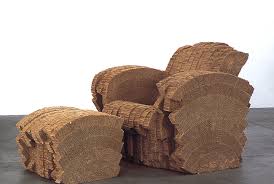 |
A chair from Gehry's "Experimental Edges"
|
 |
| One of Gehry's fish and snake lamps |
One of Gehry’s most amazing buildings created is the Guggenheim Museum in Bilbao, Spain. Through new computer software he was able to create increasingly eccentric and new shapes that were reminiscent of the International style. Some of Gehry’s latest work includes the Walt Disney Concert Hall in Los Angeles, a sports arena in Brooklyn, and another addition to the Guggenheim museum. I believe Frank Gehry is one of the most innovative and creative architectures today, and I also think that his genius will continue to astound the world for years to come.
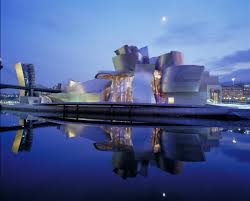 |
| The Guggenheim at Bilbao, Spain |
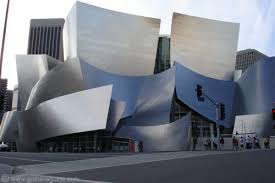 |
The Walt Disney Concert Hall
"Frank Owen Gehry : Architect Biography." Famous Architects. Web. 20 Jan. 2011. <http://architect.architecture.sk/frank-owen-gehry-architect/frank-owen-gehry-architect.php>.
"Frank Gehry Biography." Academy of Achievement. 7 July 2010. Web. 20 Jan. 2011. <http://www.achievement.org/autodoc/page/geh0bio-1>.
Ragheb, J. Fiona, ed. Frank Gehry, Architect. New York: Solomon R. Guggenheim Foundation, 2001. Print. |
Eva Zeisel
Eva Zeisel, a Hungarian industrial designer, is best known for her work with ceramics. At the young age of eighteen, she became the first female potter of the Hungarian Guild. Her exquisite work and talent led to her rise to become the artistic director of the China and Glass Industry. Despite the numerous achievements that had played out in her youth, in 1936 one of the biggest obstacles in Zeisel’s life came about. She was arrested for allegedly plotting to assassinate Stalin, and for many months she was held in various prisons. After being released she journeyed to the United States, where she rose in the ranks once again and came to be an esteemed teacher of ceramics at the Pratt Institute in Brooklyn, NY. She asked her students to imagine “how a handle would feel, how a pot would balance in the hand,” and other questions that I believe intended her pupils to think more about the objects purpose than its look. Zeisel brought her own feel to American ceramics, using her creativity to design dinnerware for the home. Some of her work shown at the Museum of Modern Art was the first one-woman show ever to be seen at the museum. Almost a century after Zeisel was born, she still works at her trade, as well as being inspiration for young designers and artists. Her view on her own artwork has been generosity; “I hoped my designs would give pleasure to the user when he had time to notice them, and yet recede when he was too busy or too tired.” I believe Zeisel’s many achievements and breakthrough’s allowed her to become a purposeful and beneficial designer to our society, both past and present, and that her work will continue to inspire people of all ages for years to come.
 Some dinnerware designed by Zeisel
"The Shape of Life by Eva Zeisel." Erie Art Museum. Web. 18 Jan. 2011. <http://www.erieartmuseum.org/exhibits/exhibits2005/zeisel/index.html>.
Young, Lucie, Eva Zeisel, Marisa Bartolucci, and Raul Cabra. Eva Zeisel. San Francisco: Chronicle, 2003. Print.
Michael Graves
Michael Graves obtained his degree in architecture from The University of Cincinnati. His interest in design allowed him to continue his education at Harvard, and under the instruction of the architect George Nelson, his interests in furniture design began to grow. His well known drawings and sketches aided him in his rise as a famous architect, leading him to create some acclaimed buildings, such as Portland Building in Oregon, the Humana Building, the San Juan Capistrano Library, the Riverbend Music Center in Cincinnati, Ohio, and the expansion of the Newark Museum. Among Graves work, one of his personal favorites is the Alessi teapot, which can still be bought today. A great accomplishment, Graves was given the title as one of the “New York Five,” five architects given credit for rooting their ideas in modernism. “Finding people to make products isn’t hard. Finding people to make them well is something else,” says the architect. His ingenuity and modern use of color have made him one of the most illustrious architects of his time, and I feel he will continue his legacy for years to come.
 The Alessi teapot
"Michael Graves : Architect Biography." Famous Architects. Web. 20 Jan. 2011. <http://architect.architecture.sk/michael-graves-architect/michael-graves-architect.php>.
Lobiondo, Maria. "Michael Graves." Princeton Online. Spring 1995. Web. 20 Jan. 2011. <http://www.princetonol.com/patron/mgraves.html>.

No comments:
Post a Comment